

Photo by Phil Levin
There’s a reason the Outdoor Writer’s Association of America (OWAA) leadership team chose Madison, Wisconsin for its annual conference this August 22–24: let’s just say it came down to numbers.
Five lakes. 270 parks. 200+ miles of biking and hiking trails.
Stats like these make Madison THE Midwest mecca for outdoor adventurists. Not to mention, it’s one of only two U.S. cities located on an isthmus, creating a one-of-a-kind, lake-city-lake landscape that blends stunning natural beauty with urban amenities.
So you can spend a morning fishing for walleye and perch, then cool down at a State Capitol tour just steps away from the lake. Enjoy a sunset paddle to the sounds of live music from the UW–Madison student union on the shoreline. Or bike from downtown to rolling hills in a matter of minutes.
As you make your 2026 conference arrangements, plan to linger longer and discover all the places that prove that in Madison, you never have to choose between outdoor adventure and city center—just choose an adventure that matches your passions.
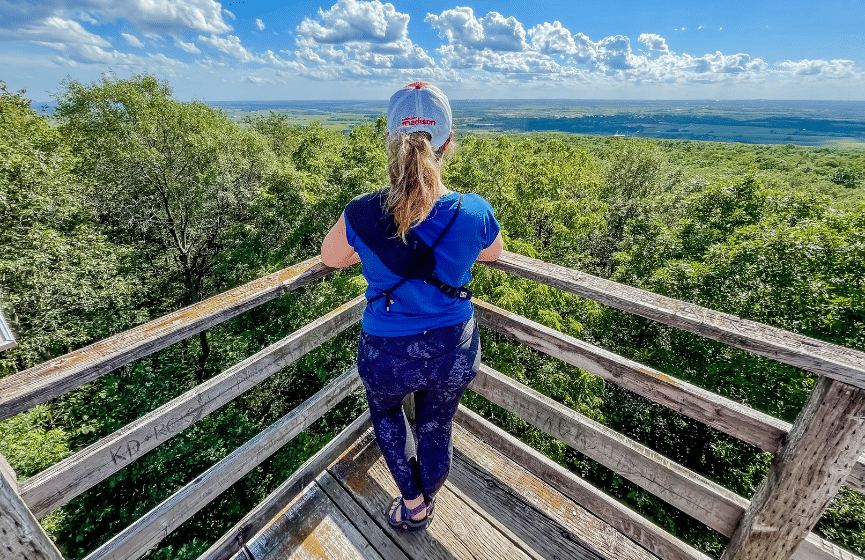
Blue Mound State Park Tower | Photo by Divergent Travelers
Impressed by iconic landmarks: Ice Age Trail
There are only 11 National Scenic Trails in the U.S. And the Ice Age Trail, contained entirely in Wisconsin, is one of the longest and most diverse. This 1,000-mile footpath was carved during the Wisconsin Glaciation period that ended 10,000 years ago. Today, its trails run through rocky terrain, open prairies and peaceful forests, offering hiking adventures that range from after-work strolls to once-in-a-lifetime thru-hikes.
The Ice Age Trail Alliance (IATA) headquarters is located in nearby Cross Plains, where you can access the Cross Plains segment of the trail, a 9.9-mile stretch of woods and restored prairies. If you begin in Verona, try the 6.3-mile segment that passes through three county parks and features several kettle ponds—remnants of the area’s glacial history—found in the Moraine Kettles Preserve.
Getting there: Verona is just six miles from Madison and Cross Plains is 15 miles away. Check the Verona and Cross Plains itineraries for ideas on local spots for eats, shops and stops to refuel on your journey.
Heads up for hunters: You can hunt deer, turkey, small game and waterfowl depending on the season. Be sure to check IATA’s helpful tips on hunting regulations and “blaze orange season” safety practices for hikers.
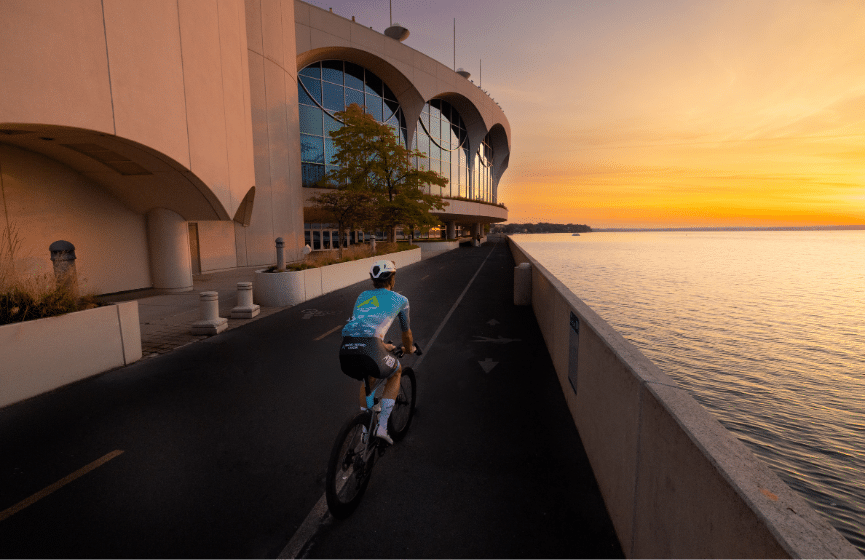
Monona Terrace Convention Center and Monona Loop | Photo by Sharon Vanorny
Do it all in a day: Devil’s Lake
If you’re looking for a spot where the terrain can change from stride to stride, check out Devil’s Lake State Park. This 10,000-acre park is situated on ancestral Ho-Chunk lands, who know it as Tee Wakącąk (Sacred Lake), where many culturally significant ancient effigy mounds remain to this day. From climbing rock formations and bluffs to hiking wooded paths and grassy trails, there are more than 29 miles of paths for varying skill levels that wind through this park.
But that’s not all. There’s swimming and watercraft rentals by the hour at the North Shore and South Shore beaches. Mountain biking on the Upland Trail where you can traverse a combination of grass and dirt terrain that climbs 350 feet in elevation. There’s also a one-mile interpretive nature trail and 1.5 miles of accessible trails for people with disabilities.
Getting there: 45 miles from Madison, an easy day trip with the option to stay and camp at one of the 423 individual sites in the park.
Stunning side trip: The waterfall at the end of Parfrey’s Glen, located just four miles east of Devil’s Lake State Park.
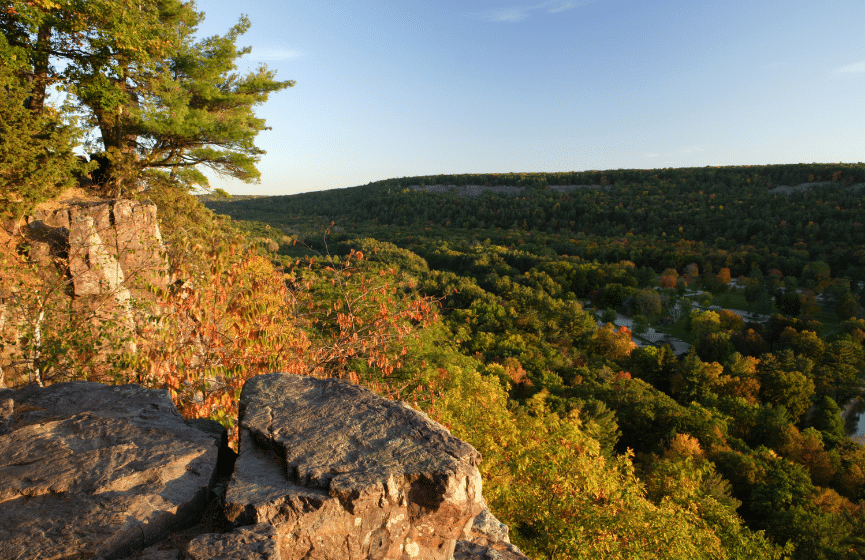
Devil’s Lake State Park | Photo by Destination Madison
Put in some miles: Military Ridge Trail
Military Ridge Trail is a 40-mile crushed limestone trail that connects bikers from Madison to Dodgeville, starting at the eastern trailhead at the Quarry Ridge Recreation Area in Fitchburg to the western trailhead at the DNR Dodgeville Service Center.
Along the way, you’ll pass through Verona, Riley, Mount Horeb, Blue Mounds, Barneveld and Ridgeway. Whether your cycling level makes this a “Half-Century” or a “Long Ride” journey, each community offers plentiful places to stop for restrooms, restaurants and refreshments.
Know before you go: A State Trail Pass is required for cycling and inline skating on this trail ($5 daily, $25 annual).
While you’re there: Military Ridge Trail runs along the southern borders of Governor Dodge and Blue Mound state parks, and both park entrances are available just off the trail.
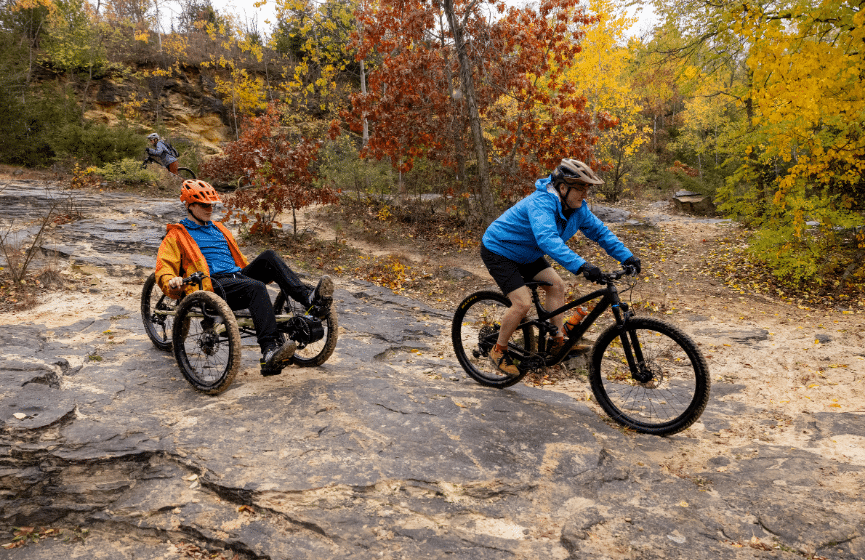
Madison trails mountain biking | Photo by Sharon Vanorny
Best views: Blue Mound State Park
If you’re looking for sweeping views as far as the eagle-eye (or camera lens) can see, don’t miss the observation towers at Blue Mound State Park. The towers are 40 feet high, affording panoramic views of the Lower Wisconsin Riverway and Baraboo Bluffs, which are particularly phenomenal in fall when the leaves are changing.
If you’re up for more of a challenge, the trails are top-notch, taking you through forest and geological formations. Mountain bikers love the dolomite and chert outcroppings that are both beautiful and challenging.
Getting there: 25 miles west of Madison, an easy day trip with the option to stay and camp at one of the 77 wooded sites or 12 bike/hike-in sites. There’s also an accessible cabin for people with disabilities.
Fun fact: Blue Mound is located atop the largest hill in the southern half of Wisconsin, thanks to a geological “quirk of fate” that left Southwest Wisconsin untouched by glaciers (now called the “Driftless Area”). On a clear day, you can see Iowa from one of two observation towers in this park.

Madison lakes ice fishing | Photo by Sharon Vanorny
A Park for Every Season: Governor Dodge State Park
Governor Dodge is one of the state’s largest parks, covering 5,000 acres of the Driftless Area. Its sandstone bluffs date back 450 million years and it’s home to wow-worthy topography: steep hills, deep valleys, two lakes and a waterfall.
It’s also why Governor Dodge is known as the most winter-friendly park: Several hills offer family thrills for sledding, cross country skiers get 12 miles of groomed trails, and snowshoeing is allowed anywhere that is not designated for skiing or snowmobiling. In summer, the park offers biking, boating, camping, canoeing, kayaking, fishing, hiking, horseback riding, hunting and swimming.
Getting there: 48 miles from Madison, with the option to camp overnight at one of 300 sites. This park also boasts an equestrian campground and remote backpacking sites.
Selfie-worthy spot: You can view Stephens’ Falls from above and below, via a quarter-mile, paved trail with accessible parking at the trailhead.
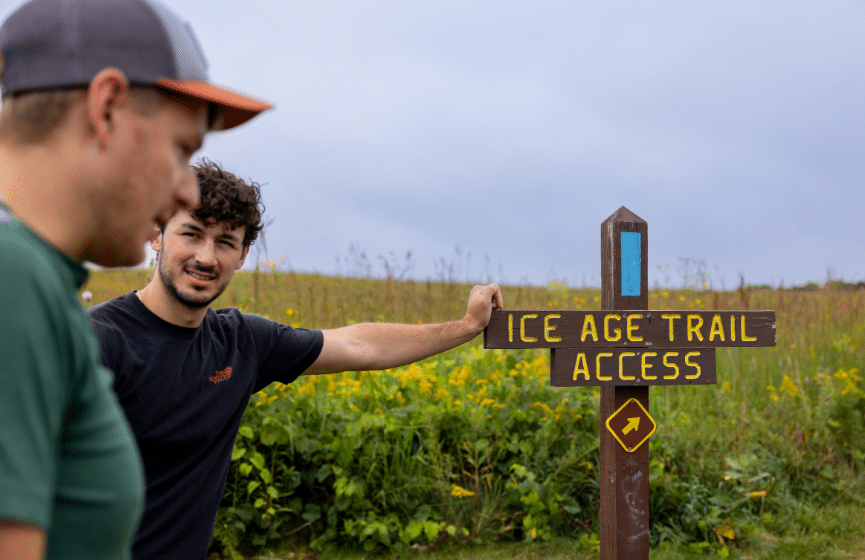
Ice Ridge Trail | Photo by Sharon Vanorny
Give back before you go: Drop-In voluntourism opps
Sustainability is a tradition in Madison: Conservation pioneer and UW–Madison professor Aldo Leopold wrote A Sand County Almanac at his farm in neighboring Baraboo, Wis.. Madison offered the first curbside recycling program in the country, starting in 1968. And Earth Day originated in Madison, inspired by former Wisconsin governor Gaylord Nelson in 1970.
So it felt natural to launch a voluntourism portal that allows visitors a chance to give back and leave our city a little better than they found it. The portal offers visitor-friendly, drop-in opportunities for activities like lake cleanup, invasive species removal and food pantry support.
No matter which of these locations you choose, one thing always remains true: Madison is THE Midwest gateway to adventure—no matter the weather. With direct flights from across the U.S. and four seasons of fun, we can’t wait to welcome you to our walkable, bikeable, hikeable destination.
Register for the conference today!
Are you an outdoor media professional or outdoor organization? Registration is now open for the OWAA conference.
Learn more and register today!
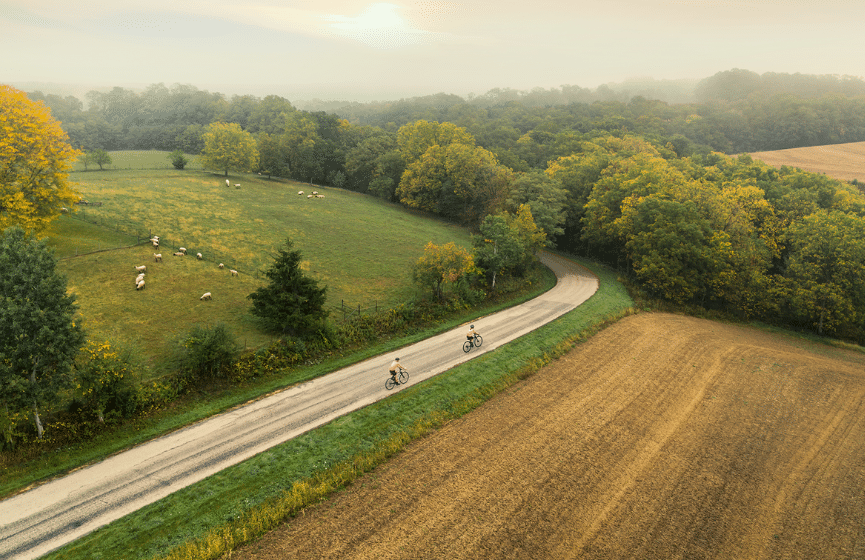
Madison rolling hills | Photo by Jason Lindsey